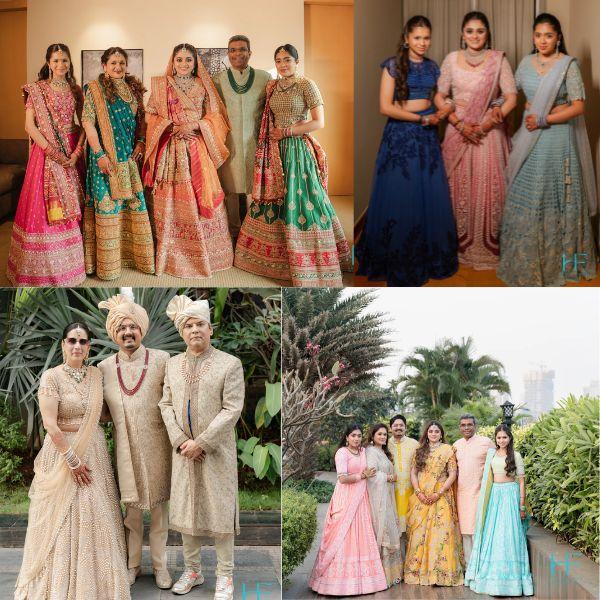
The great wedding guest debate: Must everyone match?
(Dress) Code Red: Of Pantone, Pinterest and everything in between.


Somewhere between a moodboard and a shade card lies the audacity of modern-day wedding cards, which often come with specific dress codes themed on colour. Couples may opt for Earthy-rustic, stick to tried and tested neutrals, dabble in etherealism with sage or silver, or take the avant-garde route with chrome and gothic shades (prompting an online recce to decode it all). It’s great as it lends a generic theme for the wedding, is photogenic, and etiquette-friendly.
Yet, sometimes, colour codes can lead to overconsumption if the genre is rare (not everyone has metallic wear at the ready), and there’s always room for misinterpretation (it’s colour, not cosplay). Which brings us to question the wedding trope altogether, a far from black-and-white situation.
Wedding Cards Or Shade Cards?
We’ve all been there, receiving that one destination wedding invite which demands not just travel time and expenses, but also a specific wardrobe, frequently themed around colour. It raises many questions on the opportunity costs involved, sustainability (or the lack thereof), and the increasingly performative nature of wedding celebrations today.
When did “be our guest” become this exhausting? Yet, on the other hand, it’s the couple’s day, possibly the most important one of their lives, and the spotlight is rightfully theirs. Not to forget, many find themselves answerable on social media too, with wedding films replacing sepia-toned albums of the pre-algorithm age. TLDR: If it’s for posterity, is perfection too much to ask for? It’s the bridegroom’s word against the guest’s, so we turned to a mediator to weigh in—Siddharth.
Palette Pressure
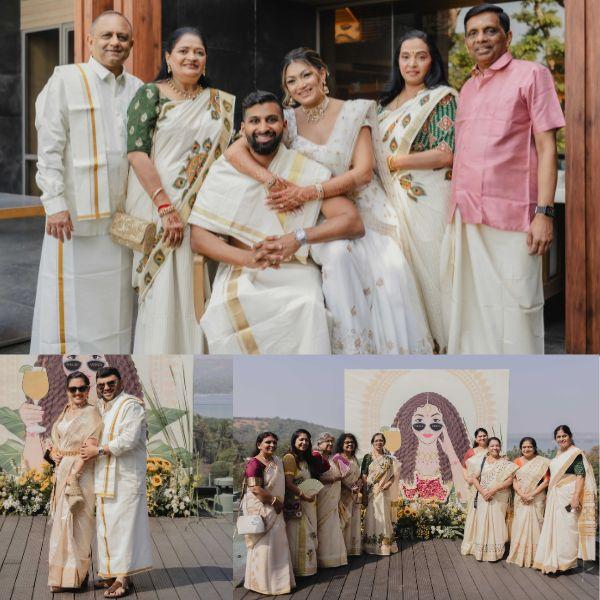
“Our counsel to couples is always the same: suggest a palette, share a mood board, but leave room for love to show up in any colour. The cohesion you are chasing in photographs comes from joy, not uniformity.” He cites the example of close relatives who have eagerly awaited this day as much as the bride and groom. “Consider the aunt who has been saving her favourite kanjeevaram for three years; she should not feel anxious about whether it fits the palette. A wedding is meant to feel like the warmest room your loved ones have ever walked into, and dictating wardrobes can quietly undo that. A compromise, not unlike manoeuvring the course of a marriage, becomes the practical solution. Bavishi shares the experiences of his clients to establish his balanced point of view.
“A Mumbai-based couple chose a sunset palette of terracotta, dusty rose, and ochre for their haldi, drawn from the bride’s wish that the décor and her guests would blend 'like a painting.” She shared a Pinterest board with her closest circle, but for the wider guest list, the invitation simply read "warm earth tones welcome. Roughly sixty per cent of guests leaned into the suggestion, and the photographs were quietly arresting, precisely because nothing felt forced.”
In another instance, a Punjabi-Marwari couple opted for two distinct palettes: soft pastels, mint, lavender, and butter yellow for the mehendi, while deeper jewel tones, emerald, sapphire, and ruby were reserved for the sangeet. “The bride’s mother, charmingly, became the unofficial stylist of the family group chat, circulating fabric swatches in the weeks before the wedding. The arrangement worked beautifully, in large part because the guidance came from within the family rather than from the couple themselves.” Small gestures like these turn colours into a playful theme, switching from strict to celebratory. In fact, sometimes, the guests have fun and turn flexible with their interpretations too.
“For a destination wedding in Udaipur, the couple requested an ivory-and-gold palette for the welcome dinner. What we found particularly interesting was the generational divide in its interpretation: older guests embraced the palette almost immediately, while younger attendees took softer liberties — hints of bronze, brushed champagne, the occasional touch of blush. The result felt layered and lived-in rather than uniform,” reveals Siddharth.
Hue’s To Blame?
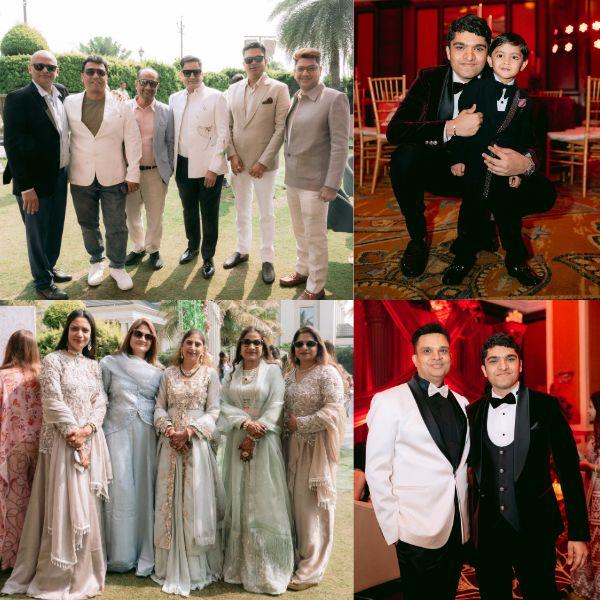
Today, as Bavishi points out, weddings continue to remain thematic, though couples are choosing the sophisticated route when walking down the aisle. “First, palettes are softening. We are seeing a clear move away from the loud, single-colour “shaadi uniform” toward harmonious palettes of three to four tones that feel curated rather than coordinated,” explains Siddharth. Next, couples are designing palettes per function rather than for the whole wedding. “This way, a guest is not being asked to overhaul their wardrobe for a three-day event.”. Third, tonal dressing is gaining credence as a pragmatic take. “Guests are invited to wear shades within one family (ivories, blush, champagne), which creates that cohesive photographic look without forcing exact-match outfits.”
Lastly, there is a small but growing counter-trend: couples explicitly saying wear what makes you happy! Take for instance, a recent client who chose to issue no colour code at all. “Save for one gentle boundary, please don’t wear white or red,” reveals Siddharth. “That single line gave them the wedding album they had imagined, without asking a single guest to feel managed or styled.”
A Match Made In Heaven
To combat the colour crisis, Bavishi suggests shifting the focus to styling as a more generic outlook. In essence, switching colour codes for mood boards. “A “no-go' rather than a “must-do” simply asking guests to avoid certain shades (often bridal red, ivory, or white) so the couple stands out.”
He further suggests choosing a fabric or texture cue, “like linens and cottons for a daytime mehendi, or metallics and silks for a sangeet” — which lends to an aesthetic without compromising on colour. For those still keen on a colour scheme, you could occupy the middleground and establish a palette range rather than a single shade. “Anything from blush to deep wine gives guests latitude while still creating visual harmony,” Siddharth explains.
There’s also playing it smart with selective, curated gifting for the inner circle. “This involves sending coordinating dupattas, pocket squares, or bandhgalas to the bridal party so they photograph cohesively, while the larger guest list is left entirely free.”
Lead image: Instagram
Also read: Beyond the lehenga: How bridal style is becoming a reflection of personality
Also read: The ultimate guide to upcycling heirloom pieces for your wedding without looking outdated
.......Advertisement....

A bride's essential guide to soft, smooth, and beautiful hands
Ring shots, holding hands during rituals, raising a toast, and countless close-ups: your hands are among the hardest-working players on your wedding day, and deserve their own beauty strategy.
The great wedding guest debate: Must everyone match?
(Dress) Code Red: Of Pantone, Pinterest and everything in between.
