Sabyasachi’s 25-year legacy shaping Indian couture and bridal luxury
The man of the moment, Sabyasachi Mukherjee is inarguably one of India’s greatest couturiers. Unabashedly maximal and Indian to the very core, yet global in his outlook and reach. Following the far-reaching success of his 25th anniversary celebrations, Brides Today dissects how the designer subverts the fabric of fashion.


The dilapidated walls were back. As were the emerald kharkhari windows, with swathes of crinkled cotton separates wrung and left to dry on jute ropes; the arena marked by dust-laden archways and verandas with scroll-bas reliefs, some 700 guests milling about before taking their velvet-upholstered seats, a strict, anticipatory hush in the air.
Twenty-five years after Sabyasachi Mukherjee launched his eponymous label with a mere investment of Rs 20,000 and a team of three, the designer celebrated his fashion empire in January-end, recreating the old-school charm of Kolkata, frozen in time, and picking up from where he left off. Smelling the waft of incense across the carpeted wooden floors of the Jio World Convention Centre in Mumbai, it was hard not to think: the walls are probably freaking out.
This wasn’t solely a trip down some weird wormhole into a whistle-stop tour of the 50-year-old designer’s iconic looks. It was a masterclass on how to learn from the past and to get most effectively to 2025. How to reevaluate and challenge everything you believed to be true. The history of India, in all its problematic dimensions, is among the most important subjects we grapple with today. Who gets to define it? How do you teach it? How do you talk about it? Designers aren’t exempt.
Sabyasachi, who was one of the first designers in India to showcase his collections at Milan Fashion Week, has had an unabashed ability to communicate his heritage through the language of craft and design without the need for overt symbolism. His deep-rooted understanding of Kolkata stems from his formative years, which he attributes to the influence of his grandmothers.
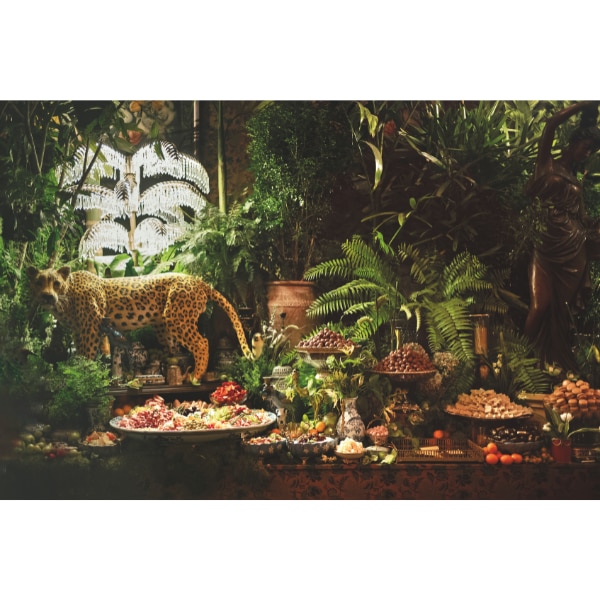
“They were the two most significant influences in my life—one taught me the power of minimalism, while the other taught me the exuberance of maximalism,” he says. It’s truly fitting that this medley of contrasts was evident at his show: the juxtaposition of the 72-foot-long grazing table—laden with satiating spreads from across the world, along with vases, sculptures, silverware and porcelain Chinese pottery—against taxidermied tigers, cheetahs and elephants transformed the environ into quite a sumptuous visual feast.
Under crystal chandeliers and incandescent strobe lights, the show opened with songs in Sabyasachi’s mother tongue, Bengali, that were composed, written and sung by Rabindranath Tagore.
“As a Bengali, I’ve had access to this excellent mix of hedonism with the sophistication of culture. This is the environment I grew up in. It shaped my consciousness,” he says.
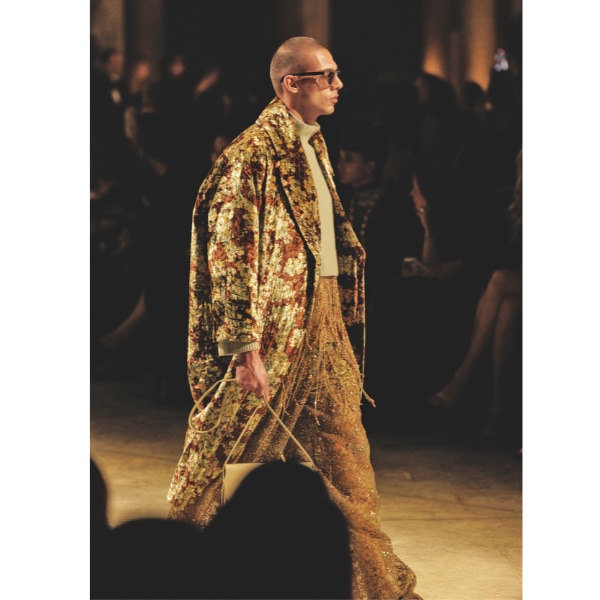
These were followed by actor Deepika Padukone walking to the medleys of ’60s hits—of Asha Bhosle and Lata Mangeshkar, coupled with Leonard Cohen and Usha Uthup numbers. She wore white cotton separates (a shirt and a pair of trousers) and a Maleficent-collared trench coat; her cat-eyed, hornrimmed glasses, Madonna-inspired crucifix jewellery and braided pompadour reminded one of the iconic actor, Rekha. The collection that followed suit proliferated into several groupings: the masculine/feminine giving way to the romantic/military influences, which further gave way to the rococo/classical, and so on. There were crop tops and razor-sharp jackets embroidered in gold bullion and paired with featherweight silk shirts tied like a bow around the neck—for men and women, no matter. Two little greatcoats had been appliquéd with three-dimensional blooms and wafted in the air with gold filigree embroidery like shadow puppets at a party. What looked like tweed on wide-legged trousers, brocade blouses, and New Look-inspired, zardosi-lined jackets turned out to be a trompe l’oeil effect that the designer and his team achieved by layering embroidery upon embroidery—a material alchemy that defied gravity and would leave Rumpelstiltskin in awe.
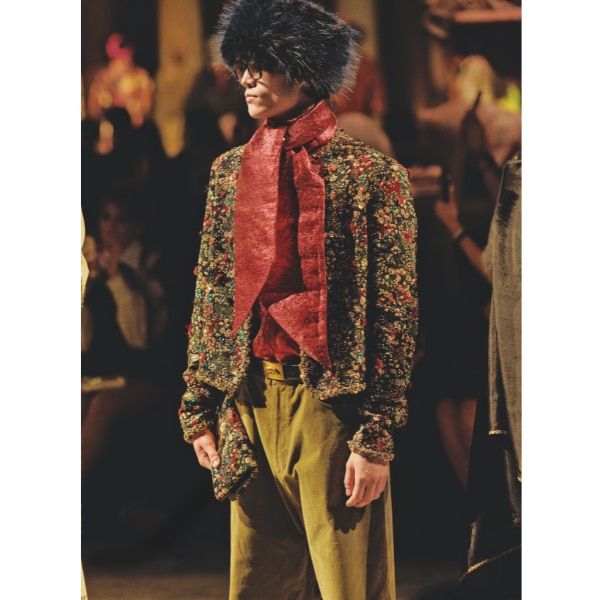
Sabyasachi also capitalised on highlighting the global prowess of craftspeople, indelibly marrying it to local artisanship. He explains, “It’s essential for luxury to tell stories about provenance, the communities and the history that bring about creation. Using traditional fabrics, heritage embroideries and generational crafts, we tell the story of local artisans and the many lifetimes of dedication embodied in each stitch.”
Case in point: the brand used the softest of cashmere loomed in the multi-generational mills of Mongolia and Scotland. They sourced denim that was made using original American machines, now in Japan, covered in diamante. The sequins were minted from Brazil, and alpaca wool was procured from Peru.
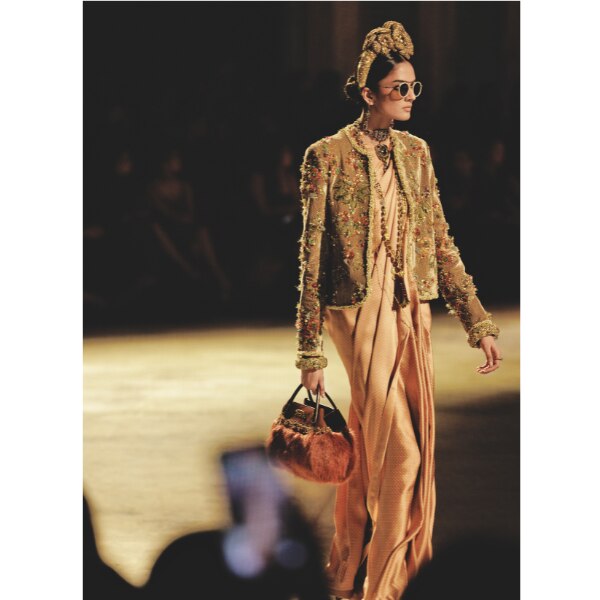
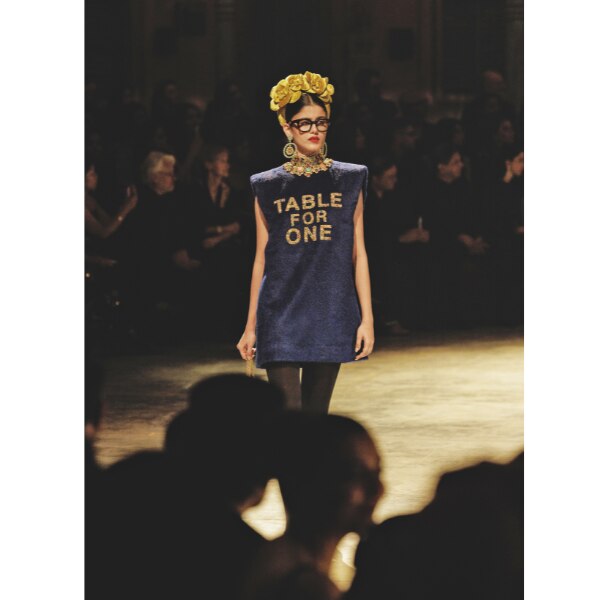
For this show, expectations were not just subverted; they were entirely redefined. It wasn’t just about who gets to wear couture or who gets to be part of the conversation— it was about what truly constitutes a couture garment: objects of the everyday and streetwear staples elevated to the level of sublime. There were “couture T-shirts” emblazoned with slogans like “Where Has Love Gone,” “Cat Lady,” “All Dressed Up, Nowhere To Go,” and “Table For One” on powdery velvets in butter yellow and midnight blue—also a subtle nod to his H&M collaboration of 2021. Out of the 150 looks, many were accessoried with Frida Kahlo-inspired headbands and jewellery with Byzantine stones like precious emeralds, rubies and sapphires, all inlaid in 24kt gold. Supermodel Christy Turlington closed the show wearing a nubby black sweater and off-white trousers, paired with swirls of gold chains that seemed to climb her torso like vines.
And if the collection had lost some of the shock of the new… Well, leave that to the audience—from journalists and buyers to celebrity acolytes—all dressed in “strictly black,” scattered here and there in their uniforms to celebrate the man generally known as India’s greatest couturier.
Sabyasachi’s business has grown into a formidable force, valued at Rs 500 crore (around US$58 million). His collaborations have only amplified his global reach: a 2017 partnership with Christian Louboutin blended the shoemaker’s iconic red-soled pumps with Sabyasachi’s signature embroidery and Indian textiles, creating an exclusive, highly sought-after collection sold at elite locations like Harrods and Bergdorf Goodman. Most recently, a limited-edition lipstick set with Estée Lauder, encased in gold and topped with his iconic tiger medallion, further cemented his status as a luxury powerhouse. Looking ahead, he plans to expand into the fragrance market, further diversifying his portfolio.
“I firmly believe that what we buy defines who we are and signals who we aren’t—why else would luxury goods exist? Objects transcend form and function to create portraits of ourselves,” he says.
The milestone show’s audacious energy cut through the discontent and silenced the endless debates about fashion’s relevance, reigniting a visceral desire to dress up and step out. Obviously, not everyone can—at least, in these clothes (honestly, very few can). But Sabyasachi’s influence is undeniable; his designs are now so widely replicated by every mass-market brand that, before you know it, there will be some version of it coming to a store near you.
This article first appeared in Brides Today, January-March 2025 print edition.
Images:Sabyasachi
Also read: Sabyasachi’s best international collaborations across fashion, beauty, and more
Also read: Bold and dazzling statement accessories every groom needs
.......Advertisement....

Inside Shuchita and Richards' beautiful Punjabi-Cantonese wedding in Sri Lanka
A love story that began at Oxford came full circle in Sri Lanka.
Heritage met high fashion at Samiksha and Karan's pre-wedding shoot at Samode Palace
The regal backdrop of Jaipur blended striking couture, architectural sensibilities, and a love story that began in London.
